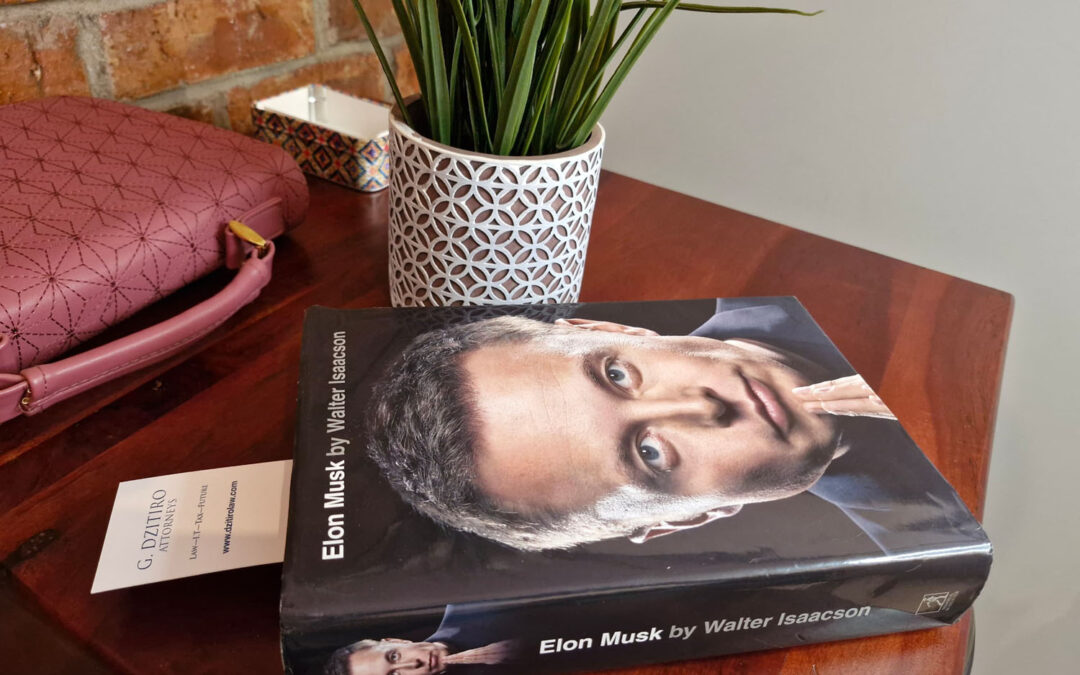
Commentary by Gamuchirai Dzitiro
This book was not written specifically for an IT lawyer or for educational purposes. However, we selected a few key observations as lessons for both businesspeople and lawyers. These lessons serve as a case study for IT lawyers, illustrated through Walter Isaacson’s detailed exploration of Elon Musk’s complexity.
Walter Isaacson’s biography of Elon Musk goes beyond the typical hero’s journey; it offers a comprehensive case study of a person inherently inclined toward risk. Isaacson’s extensive two-year effort of shadowing Musk, supported by hundreds of interviews, provides an in-depth look into this complex personality. Tracing Musk’s journey from a challenging childhood in South Africa to his status as a tech trailblazer, the biography examines his various ventures, including Zip2, X.com/PayPal, SpaceX, Tesla, SolarCity, The Boring Company, and Neuralink. It concludes with the tumultuous acquisition of Twitter, now known as X.
Several key themes emerge from the book.
One of the key concepts introduced by Isaacson is Musk’s recurring state of relentless focus that he enters during critical moments for his companies. This idea is crucial for understanding the dynamics of corporate governance and fiduciary duty within the scope of executive authority. Musk’s management style, which often involves pushing legal limits, raises important questions about the acceptable boundaries of authority in a corporate environment. His approach to innovation, characterised by a disruptive mindset, challenges established norms and prompts a discussion about how far executives can legally go in their pursuit of breakthrough solutions.
Musk’s philosophy of breaking down complex problems to their first principles is another important theme. This approach guides his entrepreneurial strategies and highlights the manufacturing processes essential to his companies. The book shows the challenges Musk faced with production at Tesla’s Gigafactory, which serves as a detailed case study in process engineering. The difficulties encountered reveal similarities with the software development lifecycle (SDLC), emphasising the complexities of scaling IT systems. Recognizing Musk’s focus on manufacturing as a key intellectual challenge provides valuable insights into the demanding nature of physical and digital product development.
Musk’s interactions with regulatory frameworks reveal a complex tension. He is often cast as seeing regulation as an obstacle to innovation, as shown by his clashes with established industries in the aerospace and automotive sectors. However, the biography also highlights his companies’ heavy dependence on government contracts and regulatory frameworks, like NASA collaborations and EV subsidies. This dual nature of regulation encourages a rich discussion about the role of law in either promoting or hindering disruptive innovation. A deeper investigation into how regulatory environments can evolve to support new technologies while protecting public safety and fairness is essential for legal professionals in the tech industry.
Perhaps the most controversial episode from the book was Musk’s acquisition of Twitter. This saga serves as a cautionary tale for mergers and acquisitions, highlighting potential pitfalls. Key legal lessons from this experience include the risks of waiving due diligence, the chaos following mass layoffs, rapid policy changes, and the complexities of content moderation and data privacy under an owner who advocates for a “free speech absolutist.” Additionally, the unexpected technical debt and infrastructure problems uncovered after the acquisition offer valuable lessons for future buyers, stressing the importance of thorough due diligence and strategic planning.
Isaacson’s narrative also explores Musk’s complex philosophy regarding intellectual property. From Tesla’s decision to open its patents to accelerate the growth of the electric vehicle market to SpaceX’s strict secrecy about its technology, Musk demonstrates contrasting approaches within the competitive landscape of fast-paced tech sectors. This contrast raises essential questions about the effects of IP strategy on innovation. A discussion about balancing the protection of intellectual property with promoting open access becomes a key issue for IT lawyers navigating this rapidly evolving environment.
Our main takeaway was that Walter Isaacson’s biography of Elon Musk offers a detailed and nuanced look at a figure who is transforming the future of transportation, energy, and digital communication. For IT law practitioners, the insights gained from Musk’s journey provide vital reflections on corporate governance, regulatory policies, risk management, and intellectual property. As Musk continues to break new ground in technology and business practices, the lessons learned from his experiences will stay relevant for future legal issues, encouraging essential discussions on balancing innovation with legal responsibility. Therefore, this biography not only depicts an iconic entrepreneur but also provides a rich ground for exploring the complex legal environment that shapes today’s technology-driven world.