Commentary by Gamuchirai Dzitiro
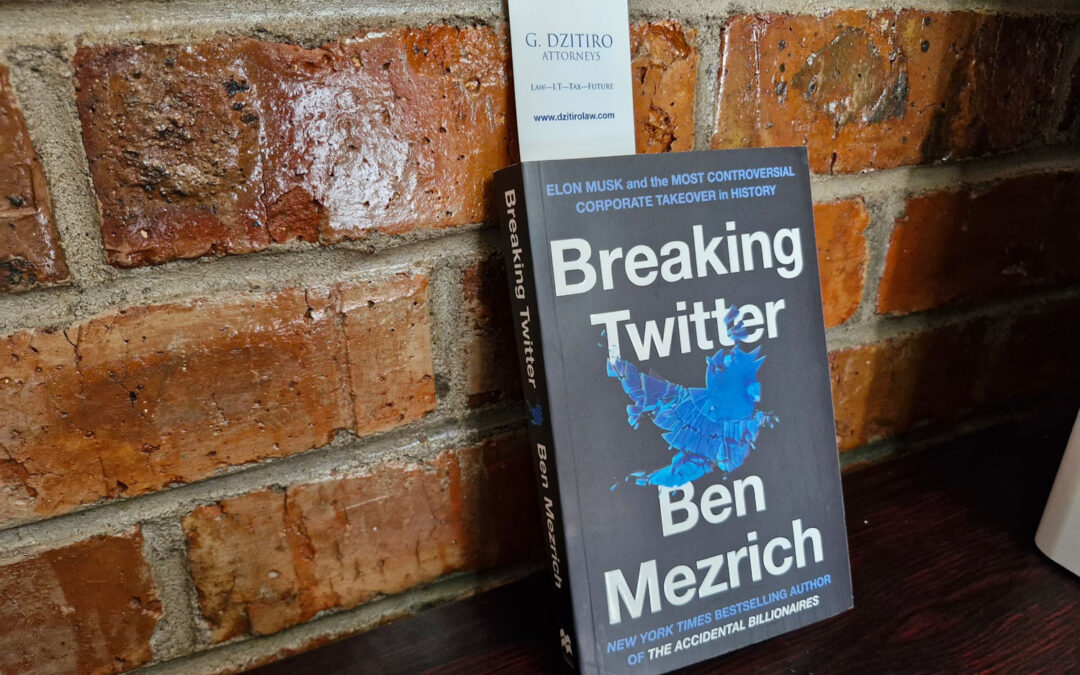
Ben Mezrich’s “Breaking Twitter” recounts Elon Musk’s takeover of Twitter through a vivid, character-driven perspective. Although it’s not a legal guide, the book offers lessons for an IT lawyer about the serious consequences of poor IT governance, weak internal controls, and the chaos—both legal and operational—that can arise when a major digital platform becomes unstable. While reading for leisure, an IT lawyer can still identify key concerns beyond the sensational story.
The book presents a compelling case study of an acquisition strategy with legal and governance implications. The central legal story begins with Musk’s use of “spam bots” as grounds to terminate the initial merger agreement. The book depicts this less as a genuine, material discovery and more as a contractual leverage. From a legal standpoint, this highlights the weaponisation of due diligence, where publicly expressed concerns over data integrity (a common IT legal issue) can be used strategically in merger and acquisition negotiations, pushing the target company into a defensive and expensive legal position to prove otherwise.
The lesson on Material Adverse Change (MAC) Clauses is vital because the subsequent legal battle shows the high threshold for proving a MAC Clause and emphasises the strategic importance of specific performance as a remedy in merger agreements. Twitter’s legal team’s success in compelling the acquisition is a key takeaway.
The author, Mezrich, vividly describes the dangers of “technical debt” and poor documentation within a company. He portrays Twitter’s pre-Musk infrastructure as a “Rube Goldberg machine” of patchwork systems, poorly documented code, and complex internal processes. He describes this as a “technical debt” that is an engineering issue and a significant legal and corporate governance risk.
The book examines the challenges of operational vulnerability and shows that a platform whose core functions are understood by only a few employees is inherently fragile. This lack of institutional knowledge represents a failure in business continuity. It also shows that the problem extends beyond operational vulnerability, including compliance and audit issues. How can a company certify its internal controls, data handling practices, or compliance with regulations (such as the EU General Data Protection Regulation (GDPR) or the Digital Services Act (DSA)) if its own systems are not fully understood or documented? This leaves the company open to regulatory actions and shareholder lawsuits.
The book discusses the impact of severe workforce downsising and its immediate legal consequences. Sudden and large-scale layoffs of a significant workforce, including teams vital to trust, safety, security, and platform integrity, created immediate and foreseeable legal risks. These risks include violations of contractual obligations, as extensive layoffs can trigger “change of control” clauses in agreements with partners, vendors, and enterprise clients, which may lead to disputes and termination of essential services.
Musk’s intentional dismantling of content moderation teams directly increased Twitter’s exposure to liability under various global regulations, including the EU’s Digital Services Act, which requires specific measures for managing systemic risks. A key conflict is shifting from a curated, policy-driven moderation approach to an almost absolute free speech stance.
The book demonstrates the practical impossibility of managing a global platform without clear, consistently enforced policies. The rapid reinstatement of previously banned accounts without a transparent process created brand safety concerns for advertisers and regulatory scrutiny worldwide.
The chaotic environment after the acquisition, including the hurried departure of key security personnel and the widespread issuance of system credentials to remaining staff, is depicted as a data security disaster. Mezrich’s story shows a complete breakdown of the principle of least privilege, which creates a high-risk setting for insider threats, data theft, and unauthorised access to sensitive user information. Such conditions are almost certain to attract investigation from data protection authorities like the FTC, which had a consent decree with Twitter regarding its data practices. The likelihood of a material breach of that decree increased exponentially.
The book mainly functions as a warning about platform governance. It is not a neutral account, but its value for an IT lawyer lies in its vivid illustration of how legal, technical, and operational risks are closely connected. It shows that a corporate takeover of a critical piece of global information infrastructure without a clear plan for its complex internal systems and legal responsibilities can lead to a chain reaction of consequences.
The main lesson is that managing a digital platform, including its technical infrastructure, internal controls, content policies, and staff stability, is not a secondary matter but a crucial factor in its legal and business success. The events in the book clearly illustrate the legal risks that can occur when governance fails.